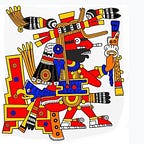

To the Aztecs the days were gods. Yep. And the Catholics too. Each day was named for a saint. That’s why they call this place San Antonio because it was Saint Anthony’s day when they held the first mass here. On a rock by the river probably or next to the Spring which was already consecrated by the People, those who had lived here for generations beyond counting and knew the spirit of the place.
I have a theory, unprovable but useful, that all great civilizations, or cultures atleast, were founded on some great sacred mystery or by some powerful shaman who knew or some inspired prophet who told them all about it: who they were and what they could become and showed them how to do it.
But all that is lost, buried in the deep prehistory of our race. All that’s left is religion and theories (like mine) and customs and traditions and stories, myths of what was and how it came to be.
And what is the value of having a god for each day if not to recognize each day as holy - a god sacred and stunning, magnificent and wondrous, presiding over the gift of time, granting blessings and powers and visions?
See one. Look around. There it is. What you see is a god manifesting their peculiar glory, never before and never again that particular vision will be or appear to be. It’s a god. I agree with the Mayans, er I mean the Aztecs, even the Catholics. I even agree with the Catholics.
And so, where does that leave us with today’s sermon? Music! That’s where!
Today I had to transport a raccoon from my backyard to an undisclosed (for security purposes) location to start her (I think it was the mother) new life in the wild outback. Three of her kids have already been transported and released at the same spot. I have discovered that raccoons like jazz so I played KRTU Early Bird Jazz all the way to the secret location (about a half hour drive). By the time we got there she was not only chill but had fallen asleep inside the live trap, her head tucked gracefully beneath her body and curled into a ball. I had to wake her up to release her.
I’m curled up. Hanging in my shelter, my nest, my habitat, habitually doing my thing with books and computers and with the jazz on. I have a whole world here and a great view. It’s green with a little yellow (the sunflowers) and their light brown stalks still standing. It’s dry. We need the god of today, Thursday the 30th to shed his (or her) blessings on us. The particular blessing that is Thursday the 30th day of August here on planet Earth in the suburbs of San Antonio. We need some Tlaloc.
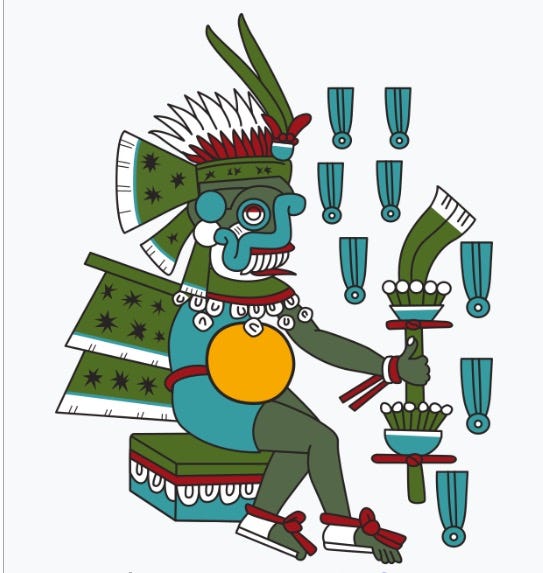
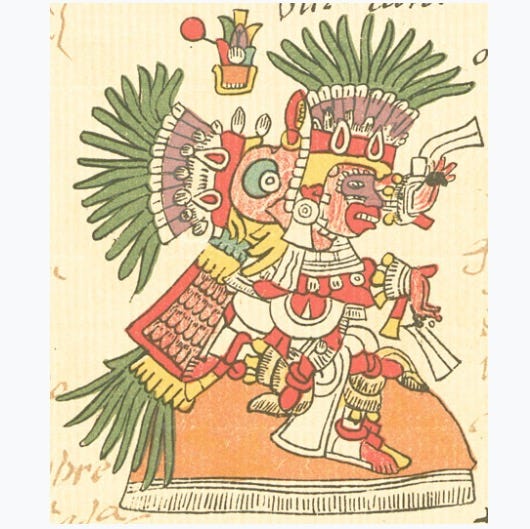
Old Tlaloc (one of my favorites) was the god of rain, thunder and lightning as well as one of the day gods. Aztec gods were multi-purpose.
I would like to suggest that there is a god of every breath. There is a god of every moment if we care to see it that way. And why not? Why wait a whole day for a new god to come aboard, enter the scene, make their appearance on the stage of life? It could be so lively, there are so many moments and so many breaths. They are all blessed by some kind of a god.
That would be lots of gods. I guess I have my own pantheon.
No names just the enchantment.
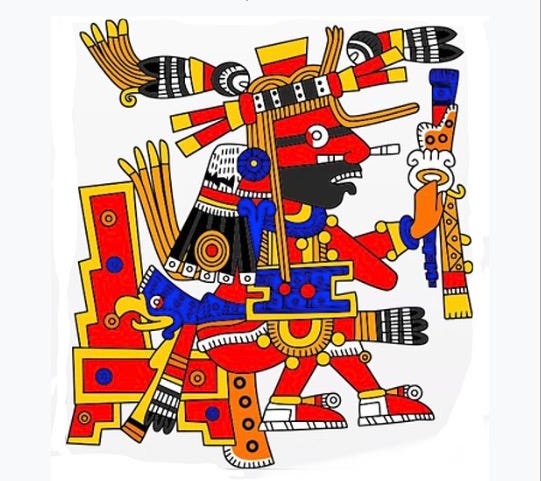
Thanks to this great playlist for the podcast music 00-5:07. I know the picture is pretty intense but he’s probably a nice guy.
You can support my work by becoming a free or paid subscriber
or by leaving a tip.
All my posts are free, and paid subscribers (thank you!) allow me to keep it this way.
Post script below copied shamelessly from Wikipedia.
“In Aztec mythology the Lords of the Day (Classical Nahuatl: Tonalteuctin) are a set of thirteen gods who ruled over a particular number, from one to thirteen. When combined with one of twenty day signs related to natural phenomena, those numbers give the names of the 260 days in the sacred calendar or tonalpohualli, from 1-Dog through 13-Water. They were cyclical, so that the same god ruled over the fate of the day with their number every thirteen days.”
Post post script
Having gods for days was not an Aztec innovation, they copied it from the Mayans along with their dual calendar system and the Mayans probably copied it from the Olmecs who came up with it back in the BC days. That means the entire Mesoamerican culture for thousands of years had been living like that - believing that the days were gods. Wow.